Monday, March 24, 2014

How the Internet chips away the MLS

Insight into the escalating war between Zillow and Move

What the Internet and Uber are doing to the taxi business is happening in its own way to real estate brokers and the MLS.
Earlier this month, Inman News reported from an industry conference that a study by Jonathan Green, vice president real estate services for CoreLogic (CLGX), found that nearly half of all homes sold last year were never listed in an MLS or were listed only after a buyer was lined up.
The MLS, that coveted and proprietary listing report that gave unique value and advantage to real estate agents using it for decades, is falling out of use in favor of more open, free listing services, such as Zillow (Z) and other off-MLS listings.
Inman reported that CoreLogic’s analysis compared public record transaction data with MLS data in four counties, and extrapolating on those findings shows that MLS use is rapidly declining.
Inman reported that Corelogic says that this raises significant questions for the industry:
Will the prevalence of off-MLS listings (or FSBOs) continue to grow?
Will behavior change in proportion to inventory?
Will brokers attempt to systematically or effectively monetize pre-MLS listings?
Will this behavior dilute the “first position” status of the MLS as a marketing engine?
Will this behavior change the perception of the MLS as the record of choice for listing and sales content?
What’s hurt the MLSs has been good for companies like Zillow. And Zillow has been aggressive in taking things to the next level as the company grows. Zillow’s website is an open listing for both real estate brokers and buyers.
In mid-March Move (MOVE) and the National Association of Realtors filed a lawsuit against Zillow and Errol Samuelson, chief industry development officer for Zillow, in a Washington state superior court, alleging breach of contract, breach of fiduciary duty and – most critically – misappropriation of trade secrets.
Samuelson was formerly president of Realtor.com and chief strategy officer of Move, Inc. Zillow also hired Curt Beardsley away from Move. Beardsley joined Zillow as vice president, industry development, responsible for building and strengthening Zillow's relationships with MLSs and other industry partners. Beardsley, 49, was most recently executive vice president of industry development of Move.
None of the parties will talk on the matter citing pending litigation, but Inman News scored an exclusive interview with Samuelson where he explained why he left Move to join Zillow.

Low Listing Inventory Continues

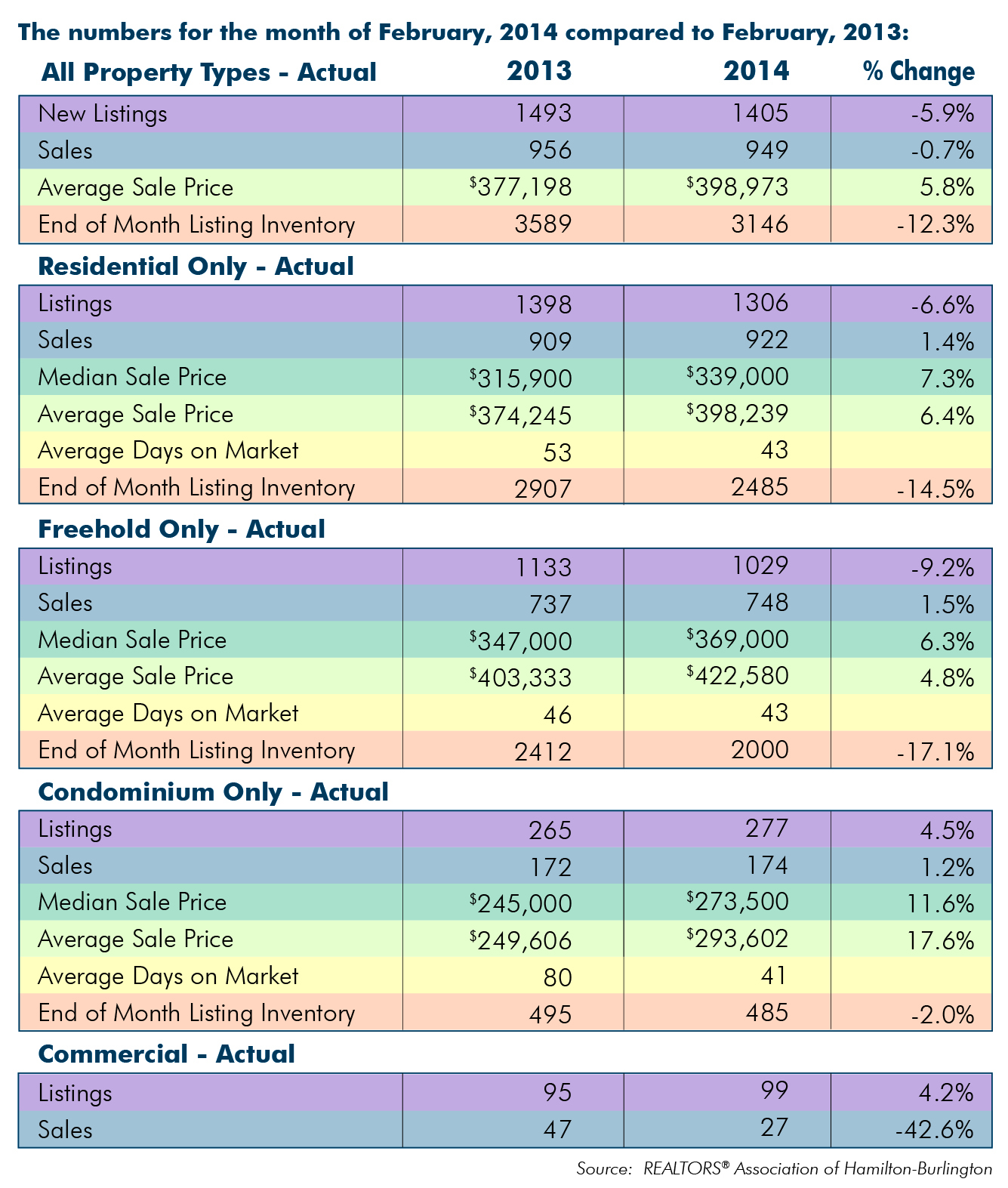
RAHB March 7, 2014 – Hamilton, Ontario) The REALTORS® Association of Hamilton-Burlington (RAHB) reported 949 property sales were processed through the RAHB Multiple Listing Service® (MLS®) system in February.  This represents a 0.7 per cent decrease in sales compared to February of last year.
There were 1405 properties listed in February, a decrease of 5.9 per cent from the same month last year.  End-of-month listing inventory was 12.3 per cent lower than last year at the same time.
The average sale price of $398,973 was 5.8 per cent higher than last February.
“The long winter seems to be having an effect on the real estate market,” said RAHB CEO Ross Godsoe. “Our listing inventory continues to be lower than average, and overall, for all property types, we are seeing fewer listings and sales compared to last year.”
Seasonally adjusted* sales of residential properties were less than one per cent higher than the same month last year, with the average sale price up 6.4 per cent for the month.  Seasonally adjusted numbers of new listings were 5.4 per cent lower than the same month last year.
Seasonally adjusted data for residential properties for the month of February, 2014:

Seasonally adjusted chart 
Actual overall residential sales were 1.4 per cent higher than the previous year at the same time.  Residential freehold sales were 1.5 per cent higher than last year while the condominium market saw an increase of 1.2 per cent in sales.  The average price of freehold properties showed an increase of 4.8 per cent over the same month last year; the average sale price in the condominium market increased 17.6 per cent when compared to the same period last year.
 “Residential sales are up a bit from last year,” said RAHB CEO Ross Godsoe. “but when you look at the bigger picture, sales are actually almost seven per cent below what is average for the month of February, based on results from the last ten years.  Likewise, listings are about 15 per cent lower than average.”
The average sale price is based on the total dollar volume of all properties sold.  Average sale price information can be useful in establishing long term trends, but should not be used as an indicator that specific properties have increased or decreased in value.
The average days on market decreased from 46 to 43 days in the freehold market and from 80 to 41 days in the condominium market.
Comparison chart 
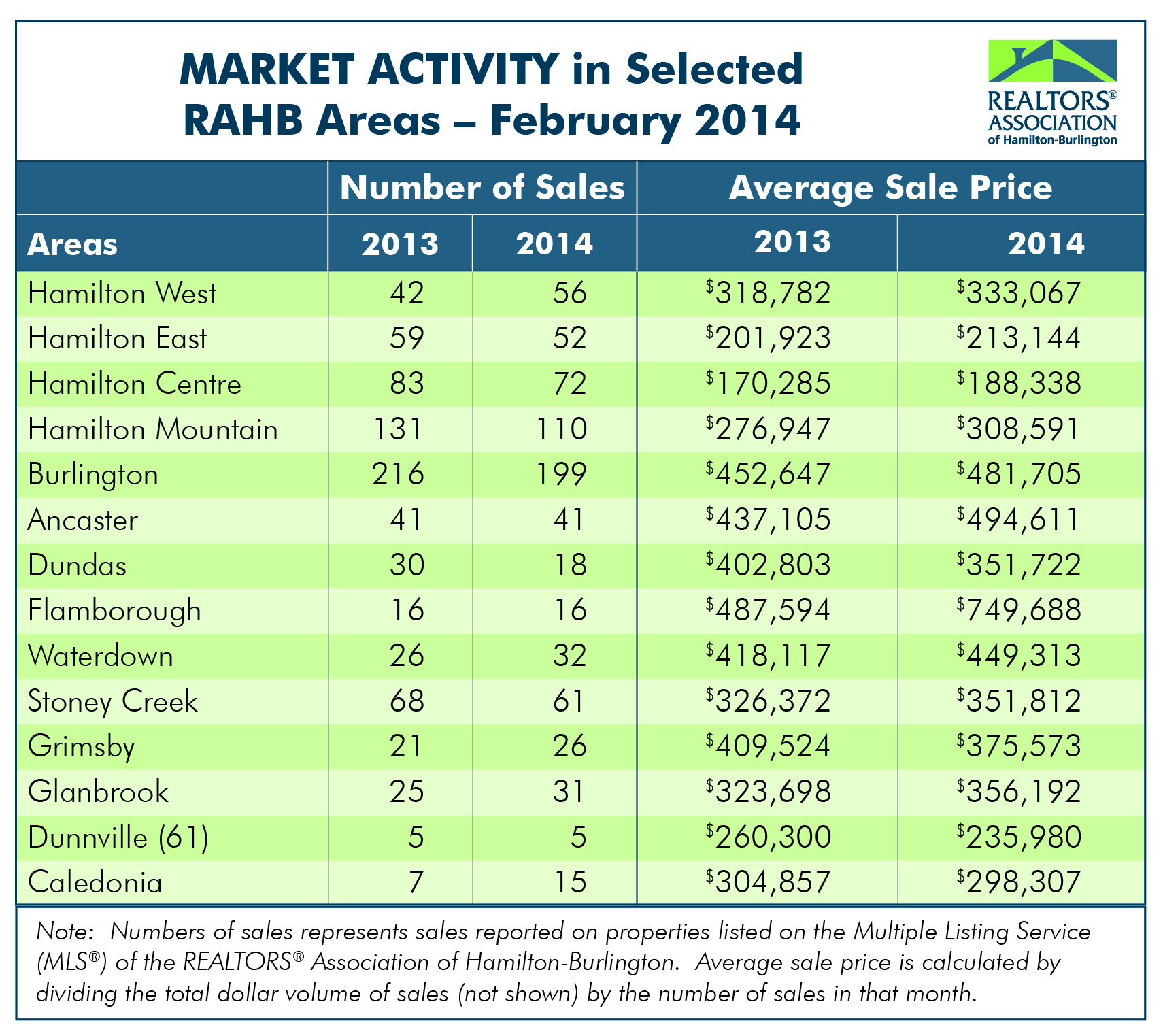
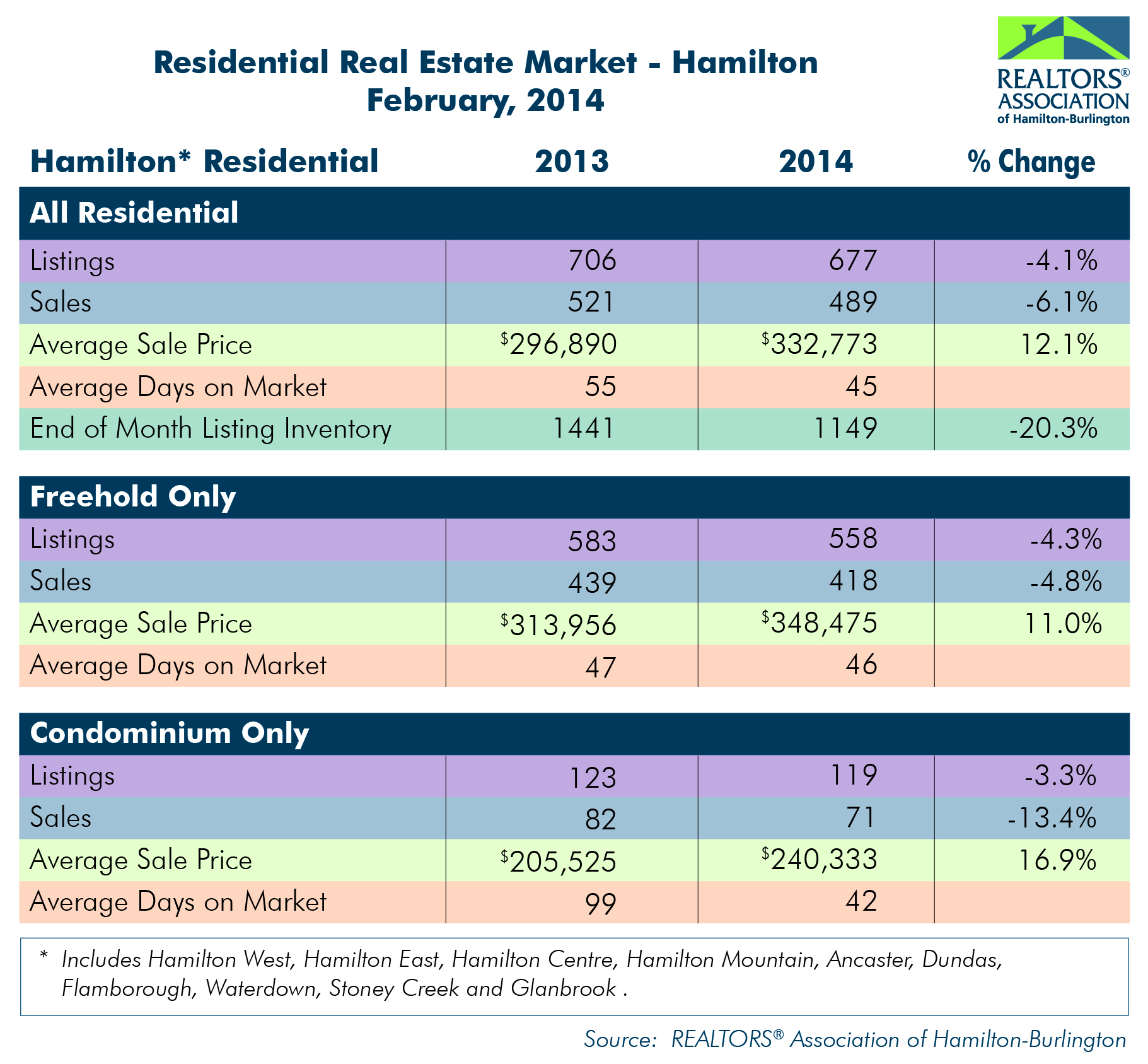
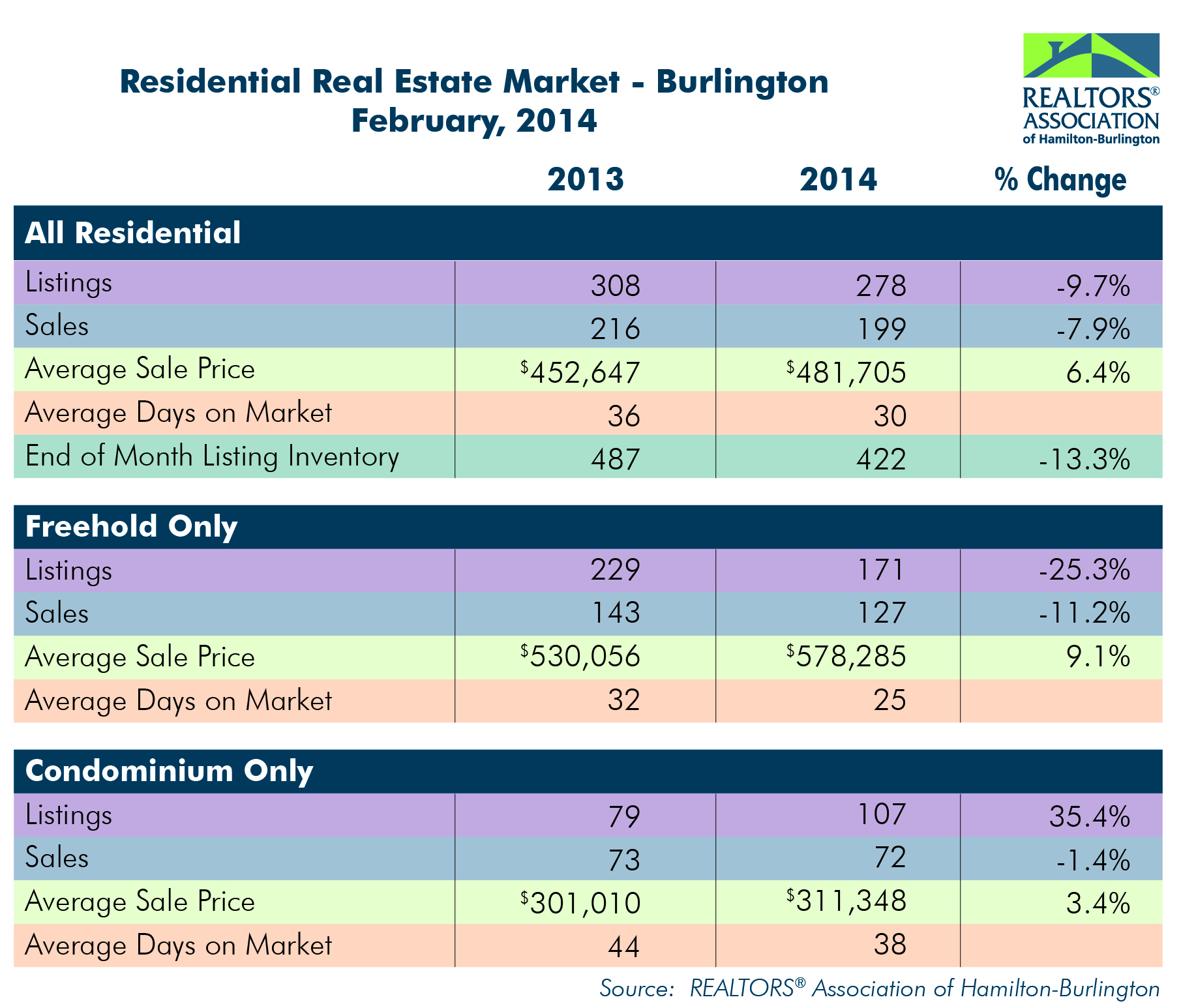
Every community in RAHB’s market area has its own localized residential market.  Please refer to the accompanying chart for residential market activity in select areas in RAHB’s jurisdiction.
*Seasonal adjustment removes normal seasonal variations, enabling analysis of monthly changes and fundamental trends in the data.
RAHB Market Activity for Feb
Ham
Burl


Charm School for Real Estate Brokers BY CONSTANCE ROSENBLUM New York Times.

Sometimes it seems as if New York brokers can’t catch a break. The stereotype is that members of the species are rude, arrogant, aggressive, and more apt to talk than to listen. While the image may be just that — a stereotype — it clings to the people who help clients buy, sell and rent houses and apartments in this sharp-elbowed metropolis.
To counter this perception, many brokerages have professional coaches on staff; others bring in outside consultants. The goal is to teach brokers to project a warm and friendly image to their clients — who themselves aren’t always the easiest people in the world to deal with — and thus to be more effective in their work.
“For many years, the field of real estate didn’t change much,” said Laura Scott, an in-house coach with Douglas Elliman Real Estate, “and the broker was mostly an order-taker. But now, thanks to the Internet, everyone has his or her mousetrap, and so brokers have to be much more skilled, much smarter. They need to be better at building relationships, at getting out of their skin and putting themselves in their clients’ shoes, better at asking the right questions and not driving deals down people’s throats. That’s what we try to teach people to do.”Read Entire Article on New York Times

Friday, March 21, 2014

TREB Question? How do I get a history on a property through MPAC?

There has been much concern of late of he changes made by TREB to drop GEOWAREHOUSE in favour of MPAC for title search information. here is a quick link to the resource with MPAC to get a full history of a property form the time it was first developed.
TREB link

Tuesday, March 18, 2014

A Manager by Any Other Name, Just Not Babysitter

  • Take. From Cracker. Jack Agent
Managing a real estate office is no easy thing, and unless you have a "specialist" that knows its nuances as your ally, you should evaluate the potential losses you haven't evaluated because of it.
I’ve heard it said that a manager at a real estate company is as useful as any of the fixtures one might find in such an office.  This could be at a first glance, after all, if a manager is the most notable resource in a firm, it shouldn’t be for his/her hands-on participation, but for the results his effective administration ignites.  In spite of what some may think about this key role, if you’re dealing with a trained, experienced professional, if you pay close attention, you just might hear the hum of that optimal operation.  Forward thinking brokers forge ahead with a good lieutenant realizing that if nothing else, that person takes the brunt of the burdensome day to day responsibilities which would otherwise tie them up.  What follows are some observations of how a manager achieves the best for all concerned, making him/her a most valued commodity in the process.
My first excursion into management at a real estate office was an eye opener, and a great springboard to launch a career.  While I didn’t know it then, the role I thought was the epitome of achievement was a far cry from that, so far as the business owners were concerned.  They underestimated the importance of this key person and thought it to be an unnecessary expense.  And though they were averse to pay a good manager, they realized that if none of them invested their time managing the office, (or as they put it “babysit” the agents), they had to hire someone to do it, lest their business run amuck.
However, before getting ahead of myself, my immersion into this role came from a chance transaction with one of the principals at a local Century 21 franchise.  In consummating that transaction the owner asked if I might be interested in a management position at his firm. After lots of discussions, a few group interviews, a thorough analysis of their situation and the existing staff, I was offered the position.  This set into motion a course that would result in an unprecedented growth and productivity in just 12-months after assuming this charge. 
Progress came at a rapid pace as a result of a careful orchestration and management of tasks, effort and time.  Nevertheless, the improvements I initiated through a new operating procedures made my job that of monitoring systems and insuring they worked optimally, while maintaining high standards by means of simple checks and balances, and constant and specific training – on everything relevant to the strategies.  As the staff and owners adapted to the changes, alliances were forged creating a cohesiveness that was unshakable – people rallied behind each campaign presented, and implemented innovation of their own, following one-on-one coaching.  Adopting the mindset of “CANI,” popularized by Anthony Robbins in his 1986 book titled Unlimited Power, I modeled all aspects of the company’s culture around the philosophy of Constant And Never-ending Improvement, and the training I developed for the staff was progressive to that end.  The company owners discovered how a good leader with a simple plan can achieve great things.  Of course they loved the results – sales of over $36 million, with an average price of $150,000; more than 220 home sold, with a staff of 18 agents, an average of one house per agent per month!  A true win-win-win situation.
To better appreciate how this unprecedented turnaround came about, keeping in mind that this 10-year old firm had up to this point never achieved this level of performance, let’s look at an excerpt from a  little book I read a few years later -- Michael Berger’s The E-Myth, which emphasized five key principles, to achieving optimum results (in any business).  What follows are those principles, which I used innately even before reading this excellent book:
Life: Your business is a way to get more out of your life.  It is more than just a job you have created for yourself, but rather, it is there to serve you.
The Law of Objectivization: View your business as separate from you - as a product of you - and you will be able to reinvent it.  It is about taking a step outside of your business, and looking at it objectively.
Working ON it not IN it: The business as a whole is the product, not the things or the services the business produces.  You need to be focused on building your business, not merely cranking out products or services.
Systemization:  View your business as an integrated system.  The system does the work, and people run the system.
Business Development Cycle:  The task of the owner is continuous development of the business through the ongoing process of innovation, quantification, and orchestration.
Essentially, my work mirrored these principles.  In addition to being the conductor of the various tasks as noted above, one key function was to always be striving for greater accomplishments – through the staff and systems.  Early on I adopted a tenet popularized by a phone company: “Telesis,” or progress intelligently planned, which reminded us of our focus.
Applying this principle, I participated in and graduated from NAR’s Council of Real Estate Broker Managers training that urged almost identical strategies…
  • Develop effective sales associates who are aligned with the company’s culture.
  • Identify and implement the critical elements of a learning program.
  • Understand & adjust your leadership style based on the individual and the situation.
  • Develop the skills necessary to coach, mentor and hold people accountable.
  • Align your recruiting & retention strategy as part of the sales development process.
  • Harness performance strategies to ensure agents will reach their full potential.
While this summary of my initiation is important in order to understand some of the steps to achieve a highly effective operation, it is but a backdrop to something a bit more comprehensive -- the question of when a brokerage ought to consider hiring a manager, and to what end.
Yes there is an added cost in hiring someone to do what you could do yourself, (sounds like the FSBO mentality to use a real estate axiom), but the benefits far outweigh them.  After all, real estate is challenging, fraught with risks, inconsistent production, and turnstile-like approach to getting into the business, huge rewards, and extraordinarily successful performers; and while there is no cookie cutter formula for managing it all, so long as what you do is effective and simple enough to follow, it is all well and good.  There are many factors that could make this job less time consuming or risky, but, there is little room to do it all or as thoroughly so as to avoid exposure and the high turnover rate.
Essentially the manager is a steward for the owner.  S/he ensures that the owners vision, even if it were to only come in to collect a check, two or three weekly, is carried out with no significant strings attached (in reference to possible problems after the fact); in other words, risk management. 
A manager’s primary role is to make it all work, and work well; profitably; seamlessly and consistently. As the leader, people will tend to follow the examples you set, and while a good producing agent sets a great example, such an agent typically isn’t the best choice for management – there just isn’t sufficient time to take someone under your wing without suffering setbacks in your own production. As the sales manager, you perform many roles.  The key is to work on getting the most of all the resources and people, and to produce the best for the customer, all while keeping a tidy profit in the end.
If a manager is anything, s/he is certainly no babysitter.  A manager is a most valuable resource, a commodity, an ally.  And, as one risk manager commented at how this manager successfully diffused a tumultuous, high risk liability claim against the owner of another Century 21 franchise, by three attorneys vying for the same house, “…he is worth his weight in gold!”  In other words, a true manager, someone with the temperance, patience and foresight to give his full commitment and do his best for your cause, is priceless, and a key person you will gladly want to invest in for all benefits and structure you, your staff and your customers will come to enjoy – a formula that leads to Telesis.

The Power of Showing Up

From Cracker Jack Agent

  • Posted by Denise Lones
  •  
  • February 7, 2014 5:12:37 PM MST 
In many things in life, including business, to be successful you have to show up. In real estate, there's more to do than just show up, there's how you spend your time while your at it. Read on for tips on how you can make the most of your business time.
When I talk about "showing up" I am referring to being present in your business and really giving it your all. "Showing Up" means picking up the phone when you would rather send an email or doing an open house and connecting with people when you would rather be hiding in your office organizing your files. It is about stepping out of your comfort zone and connecting.
Believe it or not, "showing up" has nothing to do with the amount of time you put into your business. You could sit at your desk for eight hours but if all you have done during that time is send emails, scanned the MLS, poured a cup of coffee in the resource room, and chatted with the receptionist you may have put in your time, but you have not shown up. "Showing up" means putting on the show time attitude, connecting with people, and putting the best of you into your business.
I remember when I was a managing broker, managing an office with almost 80 agents. There were some agents who were in the office constantly. I assumed when I first came to the office that these were producing agents since they were in the office, ready for work. However, I was shocked to find out that some of these agents were not very productive with low sales numbers. You would have thought that all their "showing up" at the office would be paying off. But it wasn't paying off for them because while they were putting in time they were deluding themselves that their "busy work" tasks around the office would be effective in making their phone ring. They were not taking the extra step of "showing up" and making connections with their clients.
Then I met Sarah, a fairly new agent who was hardly ever in the office. Not only was she an agent, she was also juggling being a busy mother, wife, daughter, friend, and she even volunteered at her kids' school. Although I hardly ever saw her, she was bringing the best of herself to her business and connecting with others. Her results clearly reflected that. She had no choice but to use her time and energy efficiently and didn't waste with busy work. Because of how she was showing up in her business, she was one of the top agents in the office.
I remember a conversation she and I had discussing her schedule. She said she learned that her secret to success wasn't about just putting time in your business; it was about consistently doing the things that would bring results.
If you are one of those agents who may be putting in the hours but aren't seeing the results, take note. Many agents have discovered what Sarah has, but there are still those who struggle and tell themselves that they are working just because they are busy all day long. You may be spending way too much time on the computer, in your email, or even doing the laundry or playing with the dog at home during your best work hours.
Ask yourself if you are really bringing the BEST OF YOU to your job as CEO of your own company. A CEO's job is to motivate employees, usually with a focus on money-making activities. As the CEO of your own company, what review and direction would you give yourself as an employee?
Chances are if your business isn't where you want it to be, you need to be "showing up" more and putting the energy into connecting with others. If you connect well you will sell well.
If you need to take a close look at how you show up, I encourage you to write down all your activities for a week and color code everything you do for your business that includes showing up and connecting in green and code everything else in yellow. If you are not seeing a lot of green highlights, I guarantee you will not see a lot of green dollars.
Bring the best of you to the table, show up, and watch your business soar!

By Denise Lones CSP, M.I.R.M., CDEI - The founding partner of The Lones Group, Denise Lones, brings over two decades of experience in the real estate industry. With expertise in strategic marketing, business analysis, branding, new home project planning, product development, and agent/broker training, Denise is nationally recognized as the source for all things "real estate". With a passion for improvement, Denise has helped thousands of real estate agents, brokers, and managers build their business to unprecedented levels of success, while helping them maintain balance and quality of life.

Monday, March 17, 2014

Land Transfer Tax, Crack for Toronto Politicians

Is it fear or good management that makes us take action against items of concern. Sometimes I ponder this and come up with a tie. Good intentions, 1: Fear, 1.
This is something I ponder right now as I review the actions of all levels of government towards the real estate sector over the past five years. Let's look at those major factors one by one.

1. Land Transfer Taxes. In most of Ontario there is one Land Transfer Tax. In Toronto there are two.

We can argue why, or why not there should be two taxes, but one thing is certain, the second tax is costing Toronto buyers and sellers greatly.

When you review things as a percentage, it looks very small and unimportant. For simplicity, lets use 1% at the land transfer tax for Toronto and 1% for Ontario fully acknowledging the taxes are independently calculated by equations created by political hacks.

One percent is a very small thing as compared the an entire purchase price, the one hundred percent. When we look at it in actual dollars it is much more impactive. One percent (1%) is $5,000 of $500,000 purchases. For a $1,000,000 it is $10,000, sizeable indeed for most in Toronto.

But this is not the entire story. Let's add up the two Land Tramsfer Taxes and use a simple two percentage rate (2%). We now pay $10,000 on a $500,000 purchase and $20,000 on a $1,000,000 purchase! sizeable indeed. This is enough to buy a new compact car!

The question is, would this amount impact a buyer or sellers decision to enter the market place? Would a knowledgeable buyer or seller abort a potential transaction, or even not consider selling or buying simply because of this added cost. Invariably, the answer is yes, and the evidence is great that rational people have decided to not sell their current homes because of this unfair, duplicate taxation.

Really, states the doubting Thomas. Well, for many sellers, who would need to purchase a new, smaller property as they downsize, this added cost on the purchase will change their thoughts to hold on the their property rather than to pay the two taxes on their purchase. For some this may be a half year or more of wages, a sizeable sum definitely enough to make a decision on.

Remember, in the case of most who move, there are two transactions, the sale and the subsequent buy of a property. So although each transaction affords one tax times two (Ontario and Toronto taxes). in the overall scheme of things, moving from one home to the next in Toronto is impacted by something that resembles 4% of the overall transaction of one of the properties! Wow!

The Toronto Real Estate Board in the largest real estate MLS in North America. Evidence is clear that the Toronto real estate market place is impacted greatly as rational people refuse to enter the marketplace when they otherwise might simply sell or buy because the cost of entry has become too large. Sales volumes are down substantially compared to other neighbouring jurisdictions. Listing inventory is scarce at best and multiple offer bidding on properties is commonplace. What is frightfully noticeable however is the reduced inventory of homes for sale has caused a continuing and frightening price increase as rational buyers decide if they are to enter the market, they must pay more. Simple supply and demand theory at work, restrict the supply and the price will go up.

So the market is inflated by a tax that is duplicate even with all the best intentions.

I would argue that it is this Toronto specific tax that could be the straw that breaks the back of the Canadian real estate market. As Toronto goes, so goes Canada. So if this restrictive, duplicate tax continues, it could take down not only the Toronto real estate market, it could cripple the Ontario and Canadian market as the price of Toronto properties goes up even more.

One more thing, has anyone looked at what has happened to the absolute tax dollar paid per transaction over the last few years? Today the tax in real dollars is 70% higher than when started a short five years ago. So it contributes more to the Toronto tax base, and just like an injection of a hallucination, politicians refuse to even consider its removal or withdrawal. That happens with drugs, don't it! So maybe there are even more politicians on some sort of crack, land transfer crack!

Sunday, March 16, 2014

Get a Gate Keeper for your technology choices

Inman News
Chadney Barcus Contributor

We, as agents, are notorious for looking to the next bright, shiny app to be our magic pill. We have a million apps, some partially set up, so we do not experience results before we are on to the next one.
In most cases, agents just want to sell real estate. We struggle to embrace the technology, and we get bogged down by so many choices.
What’s the solution? You appoint a gatekeeper.
The gatekeeper may be you or a member of your team, whose job is to do the research to find the products that will work best for you in your market. Implement the product and stick with it for at least six months before you start a new one or try a new one to replace a current system. At Real Estate Connect, Brad Inman challenged us to build strong relationships with our technology partners.

 See Entire Inman article

Wednesday, March 12, 2014

Ottawa’s ‘dangerous’ housing market meddling threatens jobs, economy: economist

This is an excellent article by Economist Will Dunning describing the pending 'bubble' as non existing. The problem is overzealous government hacks who are putting policies in place that overshadow an otherwise solid real estate market and make it unstable.
Read this excellent article and let me know what you think.
See the entire Financial Post Article

Tuesday, March 11, 2014

How Real Estate Agents Use Social Media to Boost Business


As anyone who has bought a house can tell you, it is not typically a do-it-yourself kind of job. Having a knowledgeable and personable real estate agent at your side is key to a smooth and successful buying experience. But with market fluctuations and the sheer number of options available to buyers and sellers, it can be difficult to find the right agent for your needs.
Cutting through the noise of traditional home mailings, billboards and even “For Sale” signs is a challenge for agents seeking clients, as well. That is why, in recent years, many real estate agents have turned to social media to promote listings and attract new clients. In this industry, agents are gatekeepers, possessing not only goods in the form of property but information as well. As such, using social media to position oneself as an expert or a leader can go a long way toward boosting a real estate business.
To get a better idea of how real estate agents use social media to boost their business standing, we chatted with some industry experts. Jan Green is a Scottsdale, Ariz., realtor specializing in green properties who uses her social media accounts to connect with new and existing clients. Julien Brandt and Heather TJ-Palmer are the CEO and Social Media Manager, respectively, of Organik SEO, a San Diego-based SEO and social media agency that serves a large number of realtors. Here are some of their best suggestions on how real estate agents can leverage social media most effectively.

Play Up Your Niche

Green House
Green’s specialization of choice is a happy coincidence, considering her last name. Using her various social media accounts and website, she has positioned herself as a leading “eco-broker” in the Scottsdale area. Green says her Google+Twitter and Facebook pages have helped her reach individuals who are interested in eco-friendly properties. In fact, she says she gets up to 20% of her referrals through social media.
“I provide value-added service that’s above and beyond what most realtors provide,” Green says. She attributes her attention to “green” (environmentally friendly) realty on social media to a number of specific sales, including one to an Atlanta-based man who was relocating to her area and found her on Google+. “Being a green realtor involves education and knowledge and understanding of green products. You have to have that and be able to walk the walk.”
An avid blogger, Green uses social media platforms to amplify the content she writes, which is just another way to prove her authority in the green real estate space. Not only that, all the social media posts linking to her blog provide linkbacks, which boosts her blog’s SEO and makes her even easier to find online.
“The more specific an agent’s niche, the easier it is to differentiate and find his or her target audience,” Brandt says. That niche can be categorical, like Green’s, or even geographical. Brandt says it’s a lot harder to stand out as a real estate agent who covers an entire metropolitan region, versus someone who caters to buyers and sellers with specific needs, such as those seeking luxury properties.

Go For the Soft Sell

Woman Laptop
Often, people describe their favorite real estate agents as friends, and will stay loyal to them as they move from property to property. Good realtors know to approach their business relationships with a friendly demeanor, meaning they’re likely to avoid the hard sell whenever possible. According to TJ-Palmer, social media is a great way to connect with clients in ways that keep agents top of mind rather than in your face.
One method TJ-Palmer suggests for real estate agents is building a Pinterest board that focuses on the community they cover. This is strategically important since Pinterest is a female-dominated social network and studies have shown that, when it comes to homes, women are often the ones making buying decisions. “I think Pinterest is crucial for real estate,” says TJ-Palmer. “It’s a really great way to show people why they should live in the community the real estate agents are selling in.”
Focusing on beautiful landmarks, community events and local resources is particularly powerful for agents attempting to make their region more attractive to buyers. Using thevisual nature of Pinterest to sell not only a specific property but also a neighborhood can prove to be a powerful tactic.
While Pinterest is a great platform for real estate agents to share their perspective, Twitter and Facebook can be used to forge relationships based on existing and prospective clients’ experiences. Brandt suggests taking note of life changes in Facebook and Twitter friends’ lives. Everything from a new job to a pregnancy can signal an upcoming home buying opportunity, so by keeping track of such changes and sending appropriate congratulations, agents can make their presence known without blatantly selling their services.
It is as true for real estate as it is for all businesses: Social media provides the tools to spread information about goods — in this case, properties — for sale. But in an industry so reliant on personality and relationships, it also gives agents the opportunity to highlight the expertise and knowledge that makes them unique. Most importantly, each social media platform gives realtors a different way to connect with clients. In a business that depends on referrals, there is no underestimating how valuable each retweet can be.
[Image Credit: Images of MoneyNick LongEd Yourdon]

Monday, March 10, 2014

What Sets You Apart?

In Real Estate Sales you need an edge. Something that sets you apart. Acreason for people to put you first, to select you as the agent they wish to work with.

What is your edge? What sets you apart? How are you different and distinguishable from others? If the answer to this question is difficult for you to answer then perhaps you have just become one of many, a commodity, if you will.

Commodities trade at market price. When there is no distinction between the best and the not so best, the price will go to the market level.

Why is it then that some Realtors can demand a premium for their services? They can maintain their margins and in fact get even more business than their neighbouring competitor. These sales people maintain their advantage through the edge they have developed, a natural or derived advantage they have found or nurtured to become a leader in their expertise.

Perhaps they have an edge simply because they are pretty people! They look, act and are good. NNot necessarily better, just good.

Perhaps they service clients beyond the norm, adding stuff to their recipe for success until the ensuing stew is more tasty for a consumer.

Perhaps they are better trained on what it is to be a real estate resource, more knowledgeable on the market place, people and how to please the consumer.

Perhaps they drive a flashier car.

What ever the reason, you need to look at them and you and determine what makes you desireable our the consumer. What sets you apart?
Once you know, then you can use your unique value proposition to advantage for more profitable business.
That is the way I see it anyway!

Darryl Mitchell

Sunday, March 9, 2014

7 Ways to Improve Your Website’s Effectiveness by LOGAN ZANELLI

Logan Zanelli wrote this excellent article on improving your website performance. Enjoy!
If you’re unhappy with your website’s performance, you’re not alone.
Everyone expects a certain level of performance from their website — bloggers want bigger lists, businesses want more sales, and non-profits want more participation.
But it doesn’t always work out the way you’d like, right? And when your site isn’t converting well, the lack of results can leave you feeling frustrated, confused, and defeated.
The good news is, it can be fixed. The great news is that correcting the problem is usually just a matter of making a few minor changes.

You need to do an evaluation of your site.

If your website isn’t bringing you the results you want, then it’s time to figure out why. To do this, you need to take a “step back” and assess your site as objectively as possible.
For the best results, try to look at your site through the eyes of your audience, and be ruthless in your critiques. The more honest you are with yourself during this evaluation, the more effective it will be.
To help you review your site, here are 7 things I look at I when I do website evaluationsfor clients.1. Website Load Speed

How long does it take your website to load a complete page? The longer your site takes to load, the more sales you stand to lose.
For more information, read Willie Jackson’s article, and you’ll learn how to speed up your website.

2. Focal Points

When your website loads, what’s the first thing on the page that grabs your attention? Is it your logo? Your photo? A banner ad?
Having the wrong element of your site as the focal point can distract people from the item you want them to take action on, so pay careful attention.

If you’re having problems finding your focal point, load up your website and close your eyes. Then, when you open your eyes again, take note what part of your site your eyes go to first.
If you’re looking for a more professional approach, Crazy Egg’s eye-tracking software is a great service you can purchase and run on your website because it places a heat map on your website, successfully showing you where people click.

3. Visual Appeal

You’ve probably heard the sayings, “content is king” or “design doesn’t matter.” Neither are true. Recent studies have shown that the visual appeal of your site makes a measurable impact on its 
effectiveness.
For example, some Canadian researchers discovered that people make a decision about whether or not they like your site within the first 1/20th of a second.
Since you don’t have much time to make a positive impression with your website, make it count.
If you don’t want to spend thousands on a new design to highlight key action items, you can highlight them in a special color and use nonverbal communication to make them stand out.

4. Color Schemes

Since each color of the rainbow affects the human brain in different ways, especially when people are 
making purchase decisions, something as simple as choosing the wrong color for your site can hurt your sales.
To prevent this, you’ll want to study the psychological effect colors have on people. For more information, here are two great resources:
  1. Color Matters
  2. The Psychological Effect of Colors (infographic)

5. Website Readability

This section involves 2 parts:
First, you need to make sure that your audience can understand your writing, meaning, you must 

write easy-to-read sentences by avoiding complicated words. In general, use the simpler word, if it exists, always.
Second, you must cater your content to how people read online. Let me explain. Jakob Nielsen discovered that people read websites in a modified “F” pattern, meaning they scan each page with their eyes in roughly the shape of a capital letter “F.” Placing your critical content within that area of your site will help drastically.
For example, see figure 1:

FIGURE 1. See how people read in a modified “F” pattern?

6. Check out the Competition

Everyone has competitors, so spend some time reviewing their sites and ask yourself these questions:
  • What are they doing differently than you?
  • How does their site compare to yours?
  • Is it more professional looking?
  • Do all of them use a similar color scheme and design style?
  • What keywords are they using that you aren’t?
Arming yourself with this competitive research helps you in three ways…
First, remember, not all of your website visitors come to your site first. Some will be aware of your competitors, so knowing about their experiences will help you make your site more effective.
Second, studying your competitors can reveal your weaknesses. Whatever they may be, study them. Ask yourself why they are doing things differently and determine if doing something similar (but better) would help your site.
Third, it helps you find ways to take advantage of your competition’s weaknesses. For example, if their site is out-dated, improve yours. Or if they’ve overlooked a service or topic, take advantage of it.

7. Make your competition irrelevant

How easy would business be if you didn’t have any competition? Real easy, right?
The next step is to identify ways you can make your competition irrelevant. There are two key ways to do this:
First, think about how you can position yourself so that you’re the market leader. To do this, niche down your topics until you have no competition. For example, if you’re a web designer, you could become a web designer for litigating lawyers.
Second, you could offer more value than your competition by finding unique services and products or by improving the value of your current services and products.
Either way, how you do this will vary based on your individual needs. For more information on positioning, I suggest you check out the book Positioning by Al Ries and Jack Trout.

Converting your evaluation into action

Once you’ve completed your website evaluation, outline your potential improvements, create a timeline for the roll out, and spend time testing and tweaking each modification before implementing the next change.
And remember, if you do it right, you’ll be able to increase conversion rates, attract more customers, and build your audience.
Photo credit: D. Sharon Pruitt
About the Author: Logan Zanelli is a Business Stylist™ who helps entrepreneurs identify problems with their brand or website through his comprehensive website evaluation service.
If you enjoyed this article, enter your email below to get free updates!
  

Thursday, March 6, 2014

Toronto Star Staff: Shortage of new listings fuels desperation among Toronto home buyers

House sales were up just 2.1 per cent in February, year over year, but prices jumped 8.6 per cent as buyers battled bitter weather and a shortage of new listings in what even many realtors are concerned is a worrisome new level of desperation to buy a house in Toronto.
The average sale price was $553,193 in February, up from $509,396 a year ago.
Just this week, the battle lines were tightly drawn on an up-and-coming street in the Coxwell and Danforth area where a renovated semi-detached house, listed for $549,000, drew a stunning 25 bids.
While the final sale price for the Rhodes Ave. home has yet to be made public, the house with its “chef’s kitchen” and “English-style garden” was expected to go for $650,000 or more thanks to the intense level of competition.
And expect more of that to come, cautions BMO Economics in a home-buying report released Wednesday that found the appetite for bidding wars is highest in Toronto, with some 44 per cent of folks surveyed saying they would get into a multiple-bidding situation in their efforts to find a house.
Vancouverites are almost equally poised for battle, at 41 per cent. Sales in Canada’s priciest city were up almost 41 per cent in February, year over year, and the average price of a detached home hit $1.36 million.
Across the rest of the country, just one in three people surveyed said they’d enter a bidding war for the house of their dreams.
Some veteran Toronto realtors have been shocked by the level of desperation among house hunters so far this year, many of whom had moved to the sidelines two years ago, expecting house prices to drop, only to be seemingly panicked that prices are now spiking further out of reach.
All that pent-up demand is hitting the market at the same time that listings are unusually low, resulting in a sort of anything-goes mentality among house hunters, armed with low-rate mortgages and battered, in many cases, from two or three bidding wars already.
The reason is simple: New listings for houses, in particular, have remained below historic norms since the recession yet interest rates have remained so low, more people are looking to buy.
January saw a dramatic decline, when new listings were down 16 per cent. And while they have been slowly creeping up as the peak spring buying season approaches, new listing were still down 1 per cent in February year over year and active listings were down 12.2 per cent as house hunters snapped up anything they could.
Some buyers are reportedly now registering bids on houses they think they like but haven’t actually had time to see yet, just so they are in the loop as the deadline for bids approaches. They know they have time to withdraw once they’ve seen the home but fear it will be gone otherwise before they can.
“Nobody is moving (and putting their homes up for sale.) The demand so far exceeds the supply that buyers are just so frustrated,” says Toronto realtor Duncan Fremlin.
“If I was a buyer, I would just relax a little bit until things calm down in six or eight weeks. As soon as the sun comes out and the crocuses and tulips pop up, listings will start picking up.”
In fact, most of the uptick in GTA house sales in February was for condominiums – where ample supply is keeping demand and prices more stable – as sales spiked by 12.5 per cent, according to Toronto Real Estate Board figures released Wednesday.
Even then, the average condo sales price was up almost 5 per cent, year over year, with the average sale price hitting $347,222 across the GTA ($372,628 in Toronto and $290,650 in the suburbs). “I think the big story is how well Canadian home sales – and even more so prices – have held up during the extremely harsh winter we have had across most of the country,” says BMO chief economist Douglas Porter.
“Clearly many people are still more than willing to brave the elements to go home shopping.”
House sales flatlined or actually declined for all housing types except condominiums, where supply remains high, according to TREB’s February sales numbers:
Sales of detached homes were down by 0.1 per cent across the GTA and most dramatically in the City of Toronto where sales declined 8 per cent, year over year, but prices were up 15.7 per cent bringing the average sales price perilously close to $1 million – the average detached in the city sold for $955,314 in February, largely reflecting the impact of intense competition.
The average price for a detached house in the 905 regions was $640,405, up 10.4 per cent over February 2013. Sales were up 3.2 per cent.
Semi-detached sales were down almost 12 per cent in the 416 region while prices were up 8 per cent to $668,298. The sales of semis in the 905 regions were up 4 per cent and prices averaged $425,052, says TREB.
Townhouse sales were down 8.8 per cent in the 416 region, but prices were up almost 21 per cent to an average of $545,043. Townhouse sales were down 4.1 per cent in the 905 regions and prices up 7.3 per cent to $400,165.See the Toronto Star Article